
My CI has helped me a lot to follow my own path.
Between Silence and Sound: Growing up with Cochlear Implants
Monday, May 4, 2026
Mia Madeleine Dönitz is an inspiring office clerk from Germany who has been deaf since childhood. Since 2007, she has been using bilateral cochlear implants (CIs) from Advanced Bionics in both ears. Mia has also authored a book about her cochlear implant success story and life with a CI, sharing her experiences and insights.
In this interview, which has been translated from German, she provides a glimpse into her life, the challenges she faced growing up with a CI, and the factors that helped her stay strong and believe in herself.
Interview with Mia
AB: You lost your hearing as a child and learned to speak thanks to a CI, attended a regular school, and have now successfully completed your training. Can you give us a little insight into your life? How did you grow up with CIs?
Mia: Yes, of course! I've been deaf since childhood and received my first cochlear implant 18 years ago, followed by my second CI two years later. They have been a part of my life from the very beginning – I can't even remember the time before that. Of course, it wasn't always easy: hearing training, speech therapy, many doctor's visits – all of that was part of it. But I always had people around me who supported me. Thanks to my family, dedicated teachers, and my own motivation, I learned to speak and attended a regular school as usual. My CI helped me a lot to forge my own path. I don't see it as a weakness, but rather as a part of me that has made me strong. And today, I'm proud to have completed my education and even written a book that might inspire others.
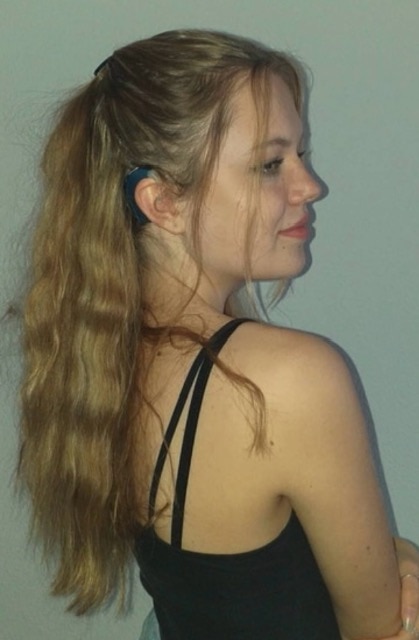
It's okay to take detours. The important thing is to persevere and believe in yourself.
AB: You also describe your life journey so far in your book, "Between Silence and Sound: My Success Story as a Deaf Person," (“Zwischen Stille und Klang: Meine Erfolgsgeschichte als Gehörlose" paperback, available in German). It's about challenges and successes, doubts, but also belief in yourself. What were your biggest challenges and how did you overcome them?
Mia: In my book, I not only talk about successes, but also about the many small and large hurdles along the way. One of the biggest challenges was definitely language. For hearing people, this is often taken for granted – but for me, it was a constant learning process. Foreign words, phrases, and sarcasm, in particular, often confused me. I didn't understand what was meant or why something was supposed to be funny. This often unsettled me, especially in social interactions. But I never gave up. I read a lot and dared to ask questions when I didn't understand something – and eventually, things got better. What helped me a lot was my own ambition, the will to be understood, and to understand others. I believe that's precisely the central message of my book: It's okay to take detours. The important thing is to stick with it and believe in yourself – even when things get difficult.
AB: You also write - "Can a small device behind the ear change your entire life?" Can you answer that with "yes"? Did it change your life?
Mia: Absolutely, yes! A small device behind the ear changed my entire life – my cochlear implant opened up the world of hearing to me. Without this implant, I wouldn't be living the life I do today. I wouldn't have learned to speak, wouldn't have attended regular school, and probably wouldn't have completed an apprenticeship – and I wouldn't have had the same opportunities. But the CI alone is, of course, just a tool. What really matters is what you do with it. It has opened up possibilities for me – but I had to walk the path myself. With a lot of practice, perseverance, and sometimes frustration. But looking back, I'm incredibly grateful that this technology exists. It not only enabled me to hear, but also gave me self-confidence. It taught me that anything is possible – even when it seems impossible at first.
My cochlear implant opened up the world of hearing to me.
Advice for Others Facing Similar Challenges
AB: What advice would you like to give to others who are in the same situation or facing the same challenges as you?
Mia: I would say: Believe in yourself – even if others might not. You're allowed to take detours. You're allowed to go slower. And you're allowed to have doubts sometimes. But never give up. Everyone has their own story and their own pace. Don't let comparisons drag you down – focus on your path. And above all: You are not alone. There are many who are going through similar experiences. Find people who support and understand you. Have the courage to accept help. Your hearing technology – whether it's a CI or a hearing aid – is a tool, but the most important part is you. You are stronger than you think.
Support from Family
AB: What advice would your mom give to other parents whose child is deaf? Why did you choose a CI for Mia? / how did she decide to get a CI for you?
Mia: My mom was and is my greatest supporter. She always believed that, despite my deafness, I could forge my own path – with the right aids and lots of love. She would advise other parents: "Exchange ideas! Seek contact with other families, with those affected, with support groups. Because this exchange can be incredibly valuable – not only professionally, but also emotionally."
The decision to get a cochlear implant was made when my mom met a father with his deaf daughter, my age, during a health resort. The girl wore a cochlear implant – and she could speak. It was clear to my mom at that moment: "I want that for Mia too." She wanted to give me every opportunity to learn language and actively participate in life.
I ultimately chose a cochlear implant from Advanced Bionics. At the time, it was the system with the widest range of sounds, meaning the most tones. This decision had a positive impact on many things in my life – and I am infinitely grateful to her for that today.
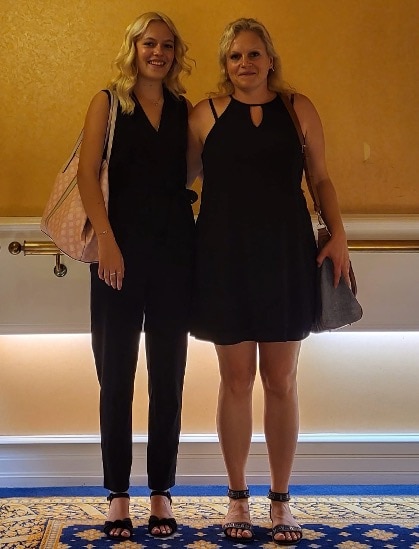
Mia and her mother, who supported her during her bilateral cochlear implant journey.
It was clear to my mom at that moment: "I want that for Mia too." She wanted to give me every opportunity to learn language and actively participate in life.
Life as a Professional with a CI
AB: Now you've successfully completed your training and started your professional life. First of all, congratulations. What's life like as a professional with a CI? Do you use accessories at work and in your everyday life?
Mia: Thank you! It feels great to be a professional now. Of course, life with a CI sometimes presents small challenges in everyday work – for example, in large meetings or when there's a lot of background noise. But I've learned to deal with them well. I actually don't use any additional accessories in my everyday life or at work – my CIs are completely sufficient for me. I get along very well with them, especially because I learned early on to communicate, ask questions, and be open about my hearing situation. Openness is key for me. If I don't understand something, I say so clearly – and most of the time my openness is met with understanding and consideration. The CI is therefore my constant companion in my everyday working life – but one that gives me the freedom to participate in life as normal.
Note: The views expressed in this post are those of the author. Each person's situation is unique so your experience may not be the same. Talk to your hearing care provider about whether a cochlear implant is right for you.


Learn
Explore
Connect
About AB
Contact Us
